


Cover Story
Some elements of design in Korea reflect the country’s industrial society. They bear the imprint of the journey and expression of Korea’s industrialization.
한국의 디자인은 산업 사회 한국의 초상이다. 거기에는 한국 산업이 걸어온 여정과 표정이 그대로 새겨져 있다.
Writer. Choi Beom
Achievements of Korean Design
In recent years, Korean products have been winning major international design awards in quick succession. In 2021, Samsung Electronics, LG Electronics and Hyundai Motor swept the International Design Excellence Awards (IDEA), hosted by the Industrial Designers Society of America (IDSA). News of awards from the Red Dot Design Award and iF Design Award (International Forum Design Award)—both part of the world’s three major design competitions alongside IDEA—also arrives nearly every year. This trend has developed over the past decade, indicating Korean design’s recent success.
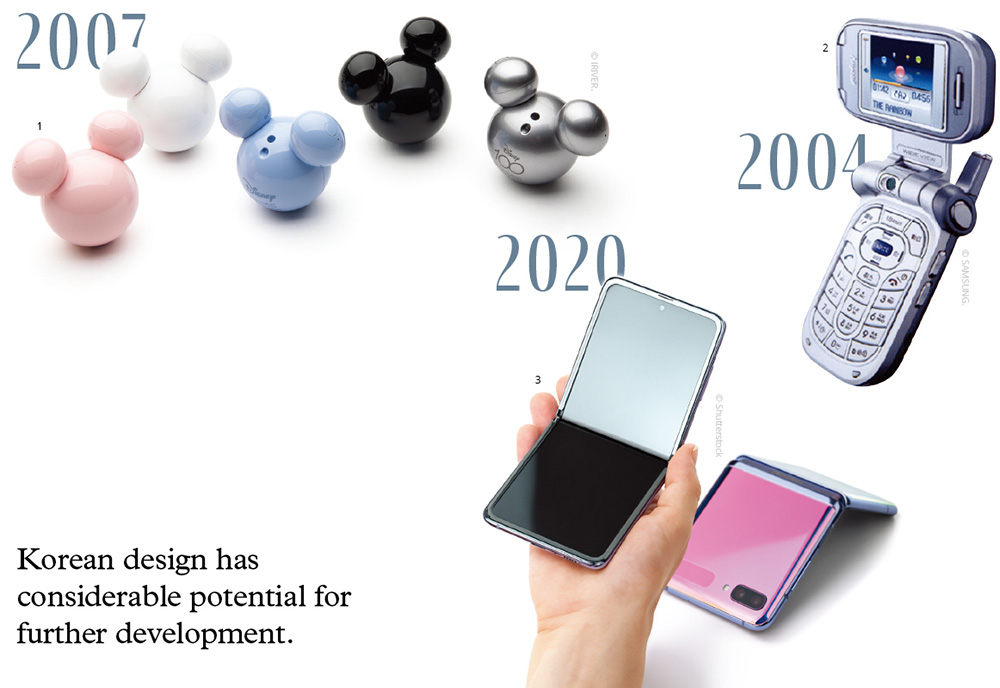
1. Mplayer Free
Wireless earbuds inheriting the design of IRIVER’s 2007 Mickey Mouse-shaped portable music player, Mplayer
2. SCH-V500, horizontal LCD phone, 2004
Samsung’s first phone with a 90° rotatable top display for horizontal viewing, designed for video calls, videos and Digital Multimedia Broadcasting (DMB)
3. Galaxy Z Flip, 2020
Foldable smartphone with a front screen, released by Samsung.
Origins and Development of Korean Design
Korean design has flourished thanks to its strong foundations and continuous development. What are the origins and foundations of design in Korea? Industrial society runs on two wheels: mass production and mass consumption. Design plays a crucial role in shaping the mass production process. Consequently, it is regarded as an essential component of industrial society. Visual design is the essential process that connects mass production with mass consumption, and advertising perfectly illustrates this concept. For this reason, advertising is often referred to as the “flower of capitalism.”
Contemporary design is intrinsically linked to the framework of industrial society, encompassing mass production, mass communication and mass consumption. Nevertheless, advancements in industry do not necessarily lead to the evolution of design, as design is fundamentally a cultural phenomenon. A society’s industrial level manifests in many ways. There are quantitative and external indicators, and there’s also the dimension of prosperity experienced in daily life. Design corresponds to the dimension where such industrial development is experienced as a cultural representation. In this sense, design can be called the face of the modern industrial nation, the Republic of Korea. Just as metalwork of the Silla Kingdom (57 BCE to 935 CE) provides insight into the technological and artistic achievements of ancient times, contemporary design serves as a clear reflection of the Republic of Korea’s present-day identity.

Angel Robotics WalkON Suit F1 Vision Concept
Next-generation wearable robot for people with lower limb paralysis designed by Move Lab led by Hyunjoon Park, winner of the 2025 Red Dot Design Award’s Best of the Best
Late industrializing countries like Korea had no choice but to develop through a catch-up approach, imitating early and late industrializers. At this stage, they couldn’t have their own unique designs and brands and had to resort to imitation manufacturing or OEM (Original Equipment Manufacturer) methods. Design only became possible once Korean industry began attaching its own brand names to products.
In this regard, the Hyundai PONY (1975) is one of the founding myths of Korean industrial design. The designer was not Korean, but here the designer’s nationality is completely irrelevant—what matters is that it was a uniquely Korean design. From then, industrial design in Korea gradually developed as the nation’s industry shifted from merely copying leading countries to embracing greater sophistication. In the case of the PONY, it was an exception that came ahead of its time, so in that sense, the true emergence of distinctly Korean industrial design had to wait a bit longer.
Korea’s industrialization started in the 1960s with strong government direction. Later, the private sector grew rapidly, leading to impressive economic growth by the 1980s. Design evolved alongside this progress, and by the 2000s, Korea had achieved notable milestones, including winning prestigious international design awards. As Korea’s industrialization centered on large corporations, it goes without saying that design development also concentrated on global products such as home appliances, mobile phones and automobiles targeted at the world market.
The living design industry in Korea continues to show significant potential for advancement. By leveraging the strengths established on the global stage and incorporating them into daily life, Korean design can achieve integrated growth, akin to Gilles Deleuze’s “rhizome” concept where roots and stems unify and expand horizontally. This approach positions Korean design to yield even greater results, presenting a meaningful opportunity and a challenge for the future of the industry.
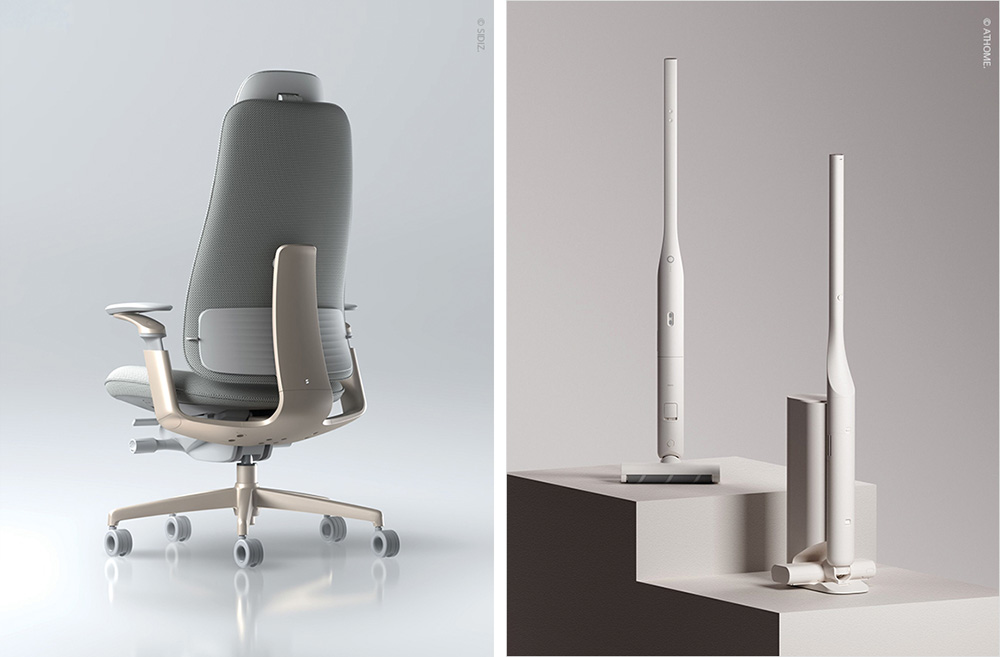
(Left) SIDIZ T90
High-end ergonomic office chair featuring state-of-the-art functions, including its perfect-fitting mechanism, winner of the 2025 iF Design Award
(Right) The Slim
Cordless vacuum cleaner by ATHOME home appliance brand MINIX, Gold winner of the 2025 iF Design Award
The Future of Korean Design
Korean industry has demonstrated significant progress in developing distinctive design solutions. Nevertheless, Korean design encounters substantial challenges ahead. These include adapting to emerging technologies such as robotics and artificial intelligence, as well as effectively integrating cultural heritage into contemporary design practices.
As K-culture continues to gain international prominence, traditional culture is also coming under increased scrutiny. While tradition represents an invaluable component of cultural heritage, merely branding something as “K-design” does not inherently confer design value. The future trajectory of Korean design will be shaped by the extent to which Korea innovatively integrates global trends with local traditions. This is because, having moved from imitation during the catch-up modernization period through the creation of unique designs, Korea now faces the contemporary challenge of fusing new technologies with culture.
Korea must carefully develop strategies to address this contemporary challenge and reduce disparities in design across various industries. By doing so, Korea has the opportunity to elevate the overall standard of design within society. This is a development that merits close observation.

PONY
Korea’s first domestically designed passenger car by Hyundai, released in 1975

WKNDR
Kia’s adventurous EV concept van, winner of the 2025 Red Dot Design Award’s Best of the Best
Writer. Choi Beom
Choi is a design critic who graduated from Hongik University’s Department of Industrial Design and the Graduate School of Aesthetics. He has served as editor-in-chief of “Monthly Design” magazine and as editor of the design criticism journal “Design Criticism.” He focuses on critically interpreting Korean society and culture through design.
